

Loading
Source: hyperice.com
The Go 3 is a quiet, light, well-priced massage gun that handles calves, forearms, shoulders and upper back without fuss. Its stall force runs out on big quads and glutes, so a lifter who trains legs hard should pair it with a bigger gun or buy the Hypervolt 3 Pro instead.
Best for: Runners, desk workers and travellers who want a pocketable massage gun
The Hypervolt Go 3 weighs 1.6 lb, runs about 55 dB and costs $149. It is a fine travel and desk gun, but it is not the only massage gun a lifter should own.
The question behind this review is narrow. Can a 1.6 lb massage gun be the only one a home athlete owns? For most people who move about 30 minutes a day, yes. For anyone who squats heavy twice a week, no, and the reason is one number.
Hyperice sells the Go 3 as the small one in a line that tops out at the $349 Hypervolt 3 Pro. It runs five speeds between 1500 and 2500 RPM, charges over USB-C, and ships with two heads, flat and wedge. The maker quotes a 55 dB noise level and up to 4 hours of battery.
Those are the figures on the Hyperice product page, and independent reviewers land close to them. One writer at Well Worth It Lab calls it small enough, cheap enough and just powerful enough to stay in rotation, which is the right way to judge it. A massage gun that lives in a drawer helps nobody.
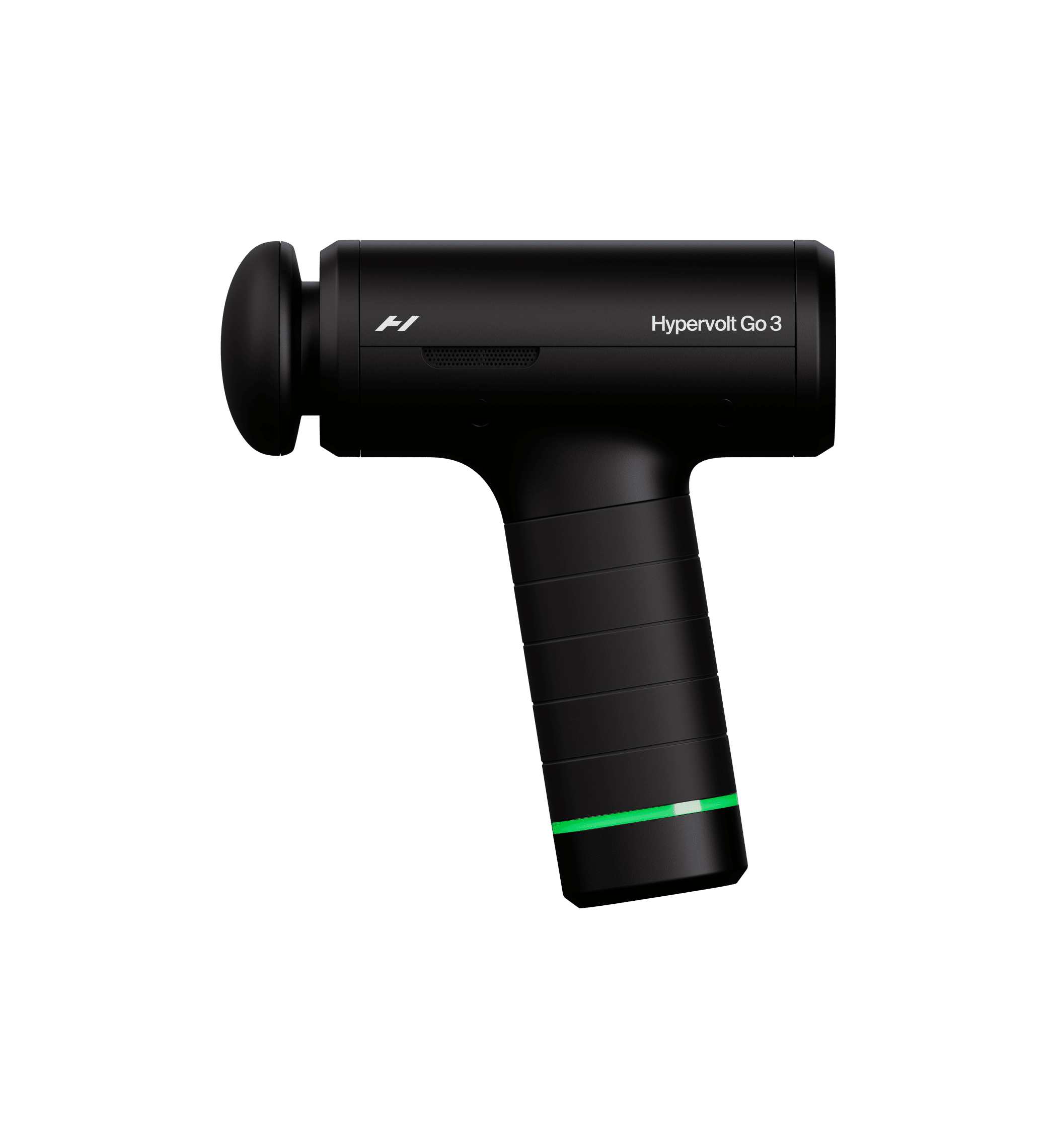
Stall force is how hard you can press before the motor gives up. Reviewers who list it put the Go 3 at roughly 45 lb. That is plenty for calves, forearms, the upper back and the neck. It is not enough to sink into a quad or a glute after a leg day, because the head slows and stutters before it reaches the tissue you wanted.
We would draw the line like this:
If you are in the third group, the answer is not to press harder. It is the Hypervolt 3 Pro, or a cheaper full-size gun, and the Go 3 becomes the travel companion. Our Hypervolt 3 Pro review covers the bigger one.
At low speeds the Go 3 is a soft whir, closer to a laptop fan than a power tool. Reviewers say the top speeds get noticeably louder and buzzier, loud enough to bother a partner in a small bedroom. Use speeds two and three for most work and the quiet claim holds.
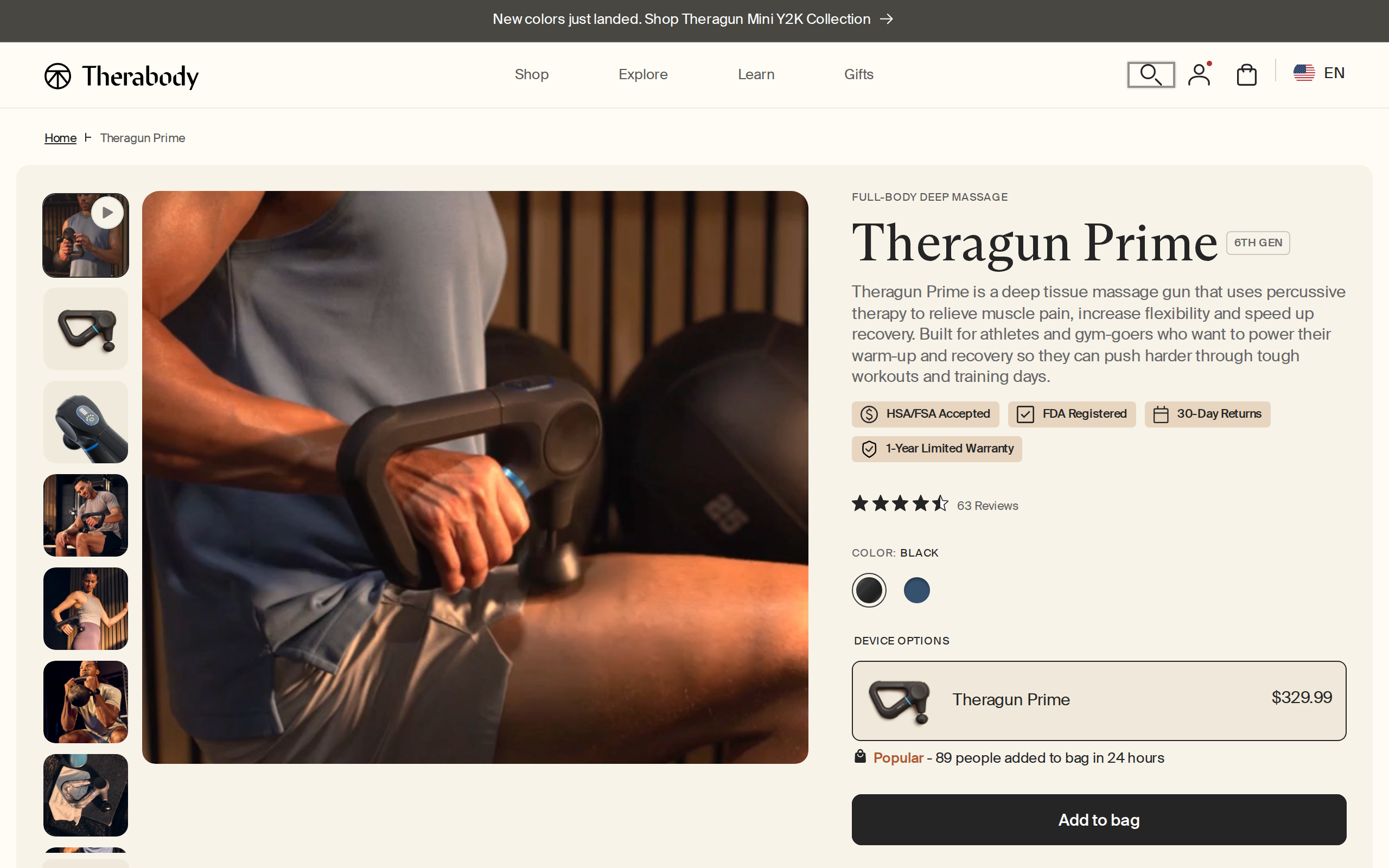
The Prime gives you the same 16 mm stroke as the dearer Theragun models for $329.99, with a long battery and a triangular handle that reaches your back. It is not quiet, the stall force is modest, and it has only two attachments. For most home lifters it is the right Theragun, but not the best massage gun per dollar.

The Hypervolt 3 Pro is the massage gun we would hand to someone who dislikes the racket of most percussion tools. It is quiet, rated at 70 lb of stall force against about 30 lb for the Theragun Prime, lasts around four hours on a charge and includes a heated head. The cost is a 14 mm stroke that goes less deep than Theragun's 16 mm, and a price $20 higher than the Prime. For most lifters it is the better buy.

Normatec 3 Legs are well built, quiet and easy to run, and they do take the edge off leg soreness. The research says that edge is small, mostly perceptual, and it costs $899. They make sense for high-mileage runners and cyclists with a recovery habit. A lifter training three days a week should buy a foam roller and a massage gun first.
The 4 hour battery figure sounds odd until you do the arithmetic. Five minutes a day is about 35 minutes a week, so a charge lasts for months of light use, and a week of daily five-minute sessions barely dents it. USB-C means the same cable that charges a phone charges the gun, which matters when the gun is in a carry-on.
At 1.6 lb it also passes the test that matters for a small gun: you will actually pack it.
The Go 3 costs $149 on the Hyperice site. The Pro costs $349 and brings six speeds and five heads. Against that, the Go 3 gives up depth and attachments but keeps most of the quiet, brushless feel that people buy Hypervolt for.

Two things we would flag. First, two attachments is thin. The flat head does almost everything, but there is no bullet for a trigger point or fork for the spine. Second, warranty terms live on a support page, so check them before you buy.
We read the maker's specifications and several independent write-ups, and we compared them line by line. The 55 dB and 4 hour figures are Hyperice's own claims, and the stall force is a reviewer figure, not a lab measurement of ours. Treat all three as good guides rather than guarantees, and note that sound meters disagree about how loud a small motor sounds in a real room with a hard floor.
Buy the Go 3 if you run, cycle, sit at a desk or travel, and you want something you will use every day. It is also a sensible first gun for anyone who is unsure they will like percussion at all.
Skip it if your main complaint is deep leg soreness after heavy lifting. Spend the extra $200 on the Pro, or look at the Theragun Prime, which our test notes favour for lifters.
Our verdict: a good small gun with an honest limit. It earns a 7.4 because it does what it claims at a fair price, and it loses points for the depth it cannot reach.